One human, many agents
In the past we improved software development by people communicating and collaborating more. We are now moving into a world where we improve things by collaborating and communicating with each other less.
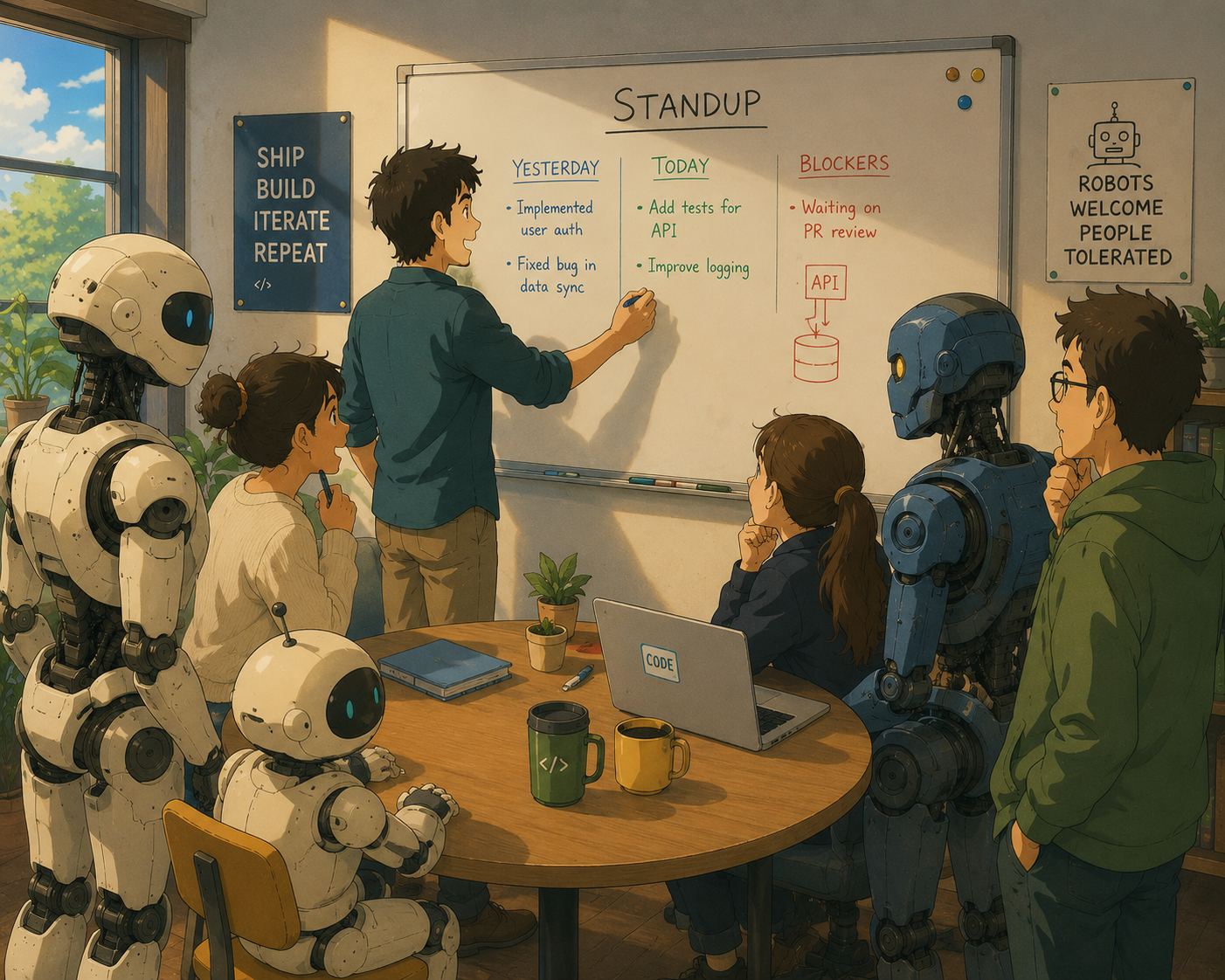
For modern software development, a single human collaborating with AI beats a larger team of humans collaborating with AI.
Work moves at the speed of the slowest link in the chain. With only one human in the loop, almost nothing is lost to meetings, status updates, and the slow ritual of one human explaining context to another human. We don't do this today because one person can't possibly do all the work. But is that still true?
That is the logical end-state of AI software development. People will still collaborate on specs and expectations. They will not collaborate on crafting the code.
Look at how we got here.
As software got more complex, we added more programmers. Then source control. Then code review tools. Then CI/CD. Then more layers on top of those. Bigger teams meant more coordination overhead, so we invented Agile to give the coordination some structure. None of that was wrong at the time. It was a response to a real problem: humans are slow, humans forget things, and humans need to talk to each other to stay in sync.
Now try to picture squeezing AI agents into that same shape. Daily standups about what the agents did overnight. Pull request reviews where a senior engineer reads 4,000 lines of generated code on a Tuesday afternoon. Sprint planning for work that finishes in twenty minutes. It sounds like AI will slot right into what we do today, and its ridiculous.
A two-person startup does not run daily standups. A small team using agents will not need most of these organizational methods either. That is not a prediction, it is just what happens when the coordination cost drops to almost nothing.
The best predictor of the future is the past. How did we behave when we had fewer humans involved with the code? When agents report back in minutes, you stop wanting to schedule meetings about them. You stop wanting to explain every change to every member of the team. The whole reason for the heavy process was that humans were the bottleneck and the work was expensive. Take the humans mostly out of the middle and the process speeds up exponentially.